Operating room video is moving from point-to-point cabling to IP networks. Here is what that shift means for surgeons, hospital IT, and new OR projects.
A modern operating room produces video from many sources: the endoscope, the surgical microscope, ultrasound, C-arm fluoroscopy, room and ceiling cameras, and PACS images pulled from the archive. Each source has to reach the right screen at the right moment, often several screens at once. For years, that meant dedicated cables and hardware matrices, each built around one fixed room layout.
That model is changing. More hospitals now treat OR video the same way they treat other clinical data: as signals carried over a network.
From cables to networks
In a conventional setup, every source connects to a display or matrix with its own cable. It works, but it is rigid. EIZO notes that direct cabling for conventional video formats such as HDMI, SDI, or DisplayPort reaches up to about 10 metres, and its own link technology extends that to 36 metres. Adding a source or rearranging the room often means new cabling.
Video over IP changes the logic. Sources and displays connect to a standard network, and any source can be routed to any screen through software. EIZO states that with fibre optics and IP-based video management, 10 Gbit signals can travel up to 400 metres. The video no longer has to stay inside the room where it was captured.
What this looks like in practice
EIZO’s CuratOR Alipe is one example of this approach. EIZO describes it as an IP-based system that carries video, audio, and control data over standard networks without compression losses, at 4K UHD and 60 Hz. Modality connections can be placed anywhere in the room, which suits modular and hybrid OR designs.
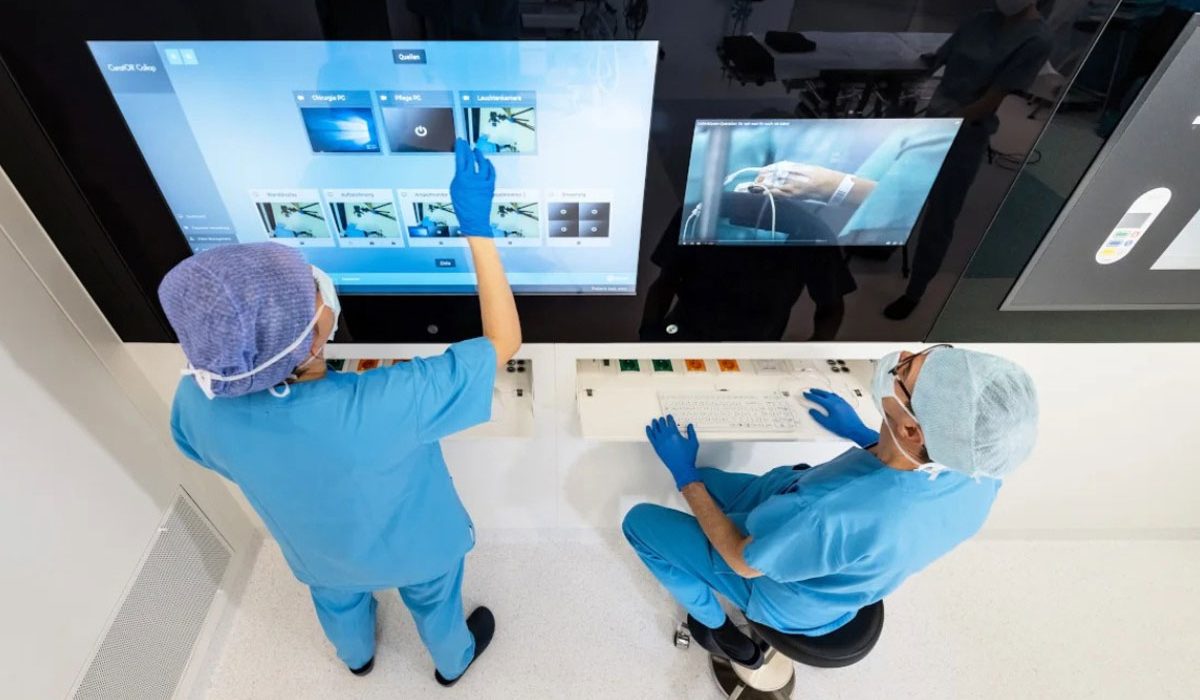
For the surgical team, the difference shows up at the table. Staff can switch sources, start recordings, and change screen layouts from a touch panel. Several signals can appear together, side by side, as picture-in-picture, or in a four-way split view. EIZO’s Caliop software controls routing and presets, records image and video documentation in the room, and can export it to the central PACS archive. Integration with hospital information systems and PACS runs through DICOM and HL7.
Why the shift matters
Flexibility over the life of the room. An OR is planned for 10 to 15 years of use, while imaging equipment changes far more often. A network-based design lets a hospital add new sources later without rebuilding the room. EIZO says its system works independently of device manufacturers, so third-party equipment can connect.
Video beyond the OR. Once video runs on the network, it can reach a teaching room, a conference hall, or a remote expert, subject to the hospital’s own consent and data policies.
A single documentation workflow. Recording and archiving to PACS from the room reduces manual file handling after the case.
What to plan for
Moving video onto the network makes the network part of the clinical system. Three questions deserve attention early in any project:
Network design. Uncompressed 4K video needs substantial bandwidth. OR video traffic usually needs its own segment or dedicated infrastructure, planned with hospital IT from the start.
Fallback. Surgery cannot stop because a switch fails. EIZO states it offers fallback concepts for different failure scenarios, such as additional direct connections if video management fails. Hospitals should define these scenarios before installation.
Cybersecurity and governance. Video and patient data on a hospital network fall under the same security and privacy requirements as other clinical systems. Procurement teams should bring IT security in at the specification stage, not at commissioning.
IP or SDI?
IP is not the only answer. EIZO also offers video integration through 12G-SDI matrices, and for a single room with a fixed layout, a conventional approach can still be the simpler choice. IP shows its value when a hospital plans several ORs, hybrid rooms, central video distribution, or expansion over time. The right choice depends on the project, not the trend.
Talk to ARJ Medical
ARJ Medical is the authorized EIZO distributor in the UAE and neighbouring countries. If you are planning a new OR, a hybrid room, or an upgrade to existing video infrastructure, our team can help you assess the options and specify a complete EIZO CuratOR solution, from surgical displays to video management and documentation.