
Time Is Brain: Every Minute in Stroke Care

In acute stroke, every untreated minute costs brain tissue. How AI imaging support helps stroke teams move from first scan to treatment decision faster. “Time is brain” is one of the most repeated phrases in emergency medicine, and the numbers behind it explain why. In a landmark 2006 analysis in the journal Stroke, Dr. Jeffrey Saver estimated that in each minute of a typical large vessel ischemic stroke, 1.9 million neurons, 14 billion synapses, and 12 km of myelinated fibers are destroyed. Put another way, compared with the normal rate of neuron loss in brain aging, the ischemic brain ages 3.6 years each hour without treatment. Effective treatments exist. Clot-dissolving drugs and mechanical thrombectomy, the physical removal of a clot from a blocked artery, can restore blood flow and change a patient’s outcome. Both depend on fast, confident decisions, and most are based on brain imaging.
Where the minutes go
A stroke pathway is a chain of handovers: arrival, scan, interpretation, treatment decision, and often transfer to a center that can perform thrombectomy. Each step takes time, and imaging interpretation is often the bottleneck. Many hospitals, especially smaller ones and those working at night, do not have a neuroradiologist on site around the clock. A scan that sits waiting for expert review can cost the minutes that matter most.
How AI imaging support fits in
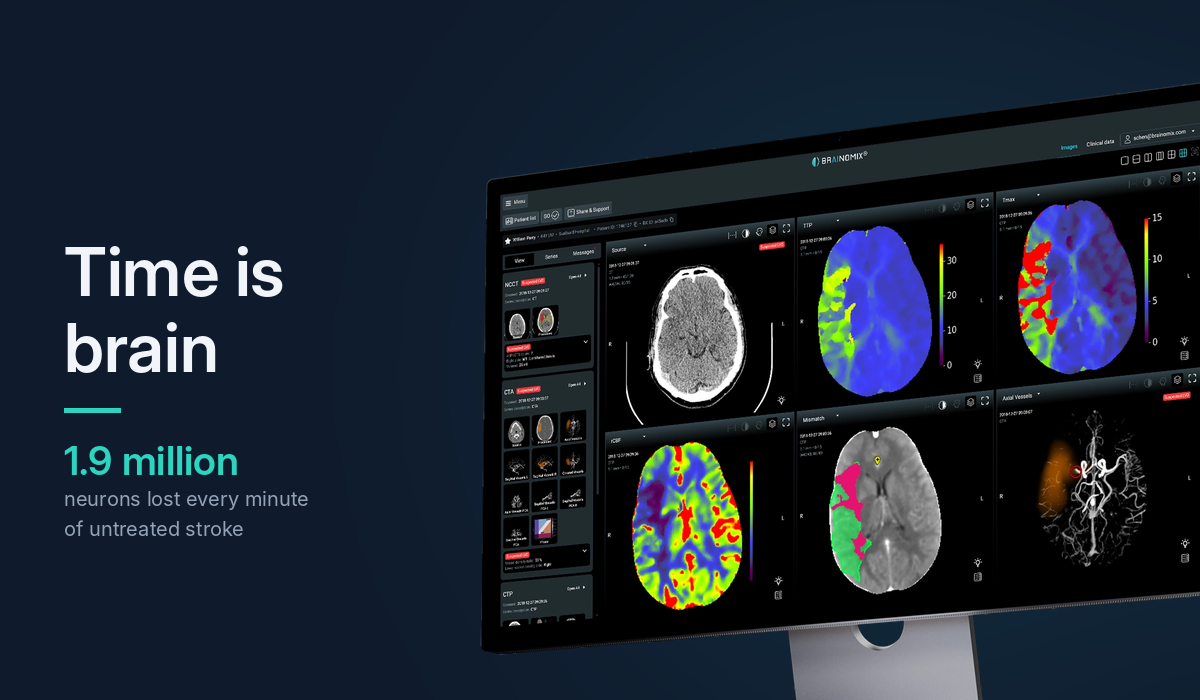
Brainomix 360 Stroke is one AI platform designed to shorten this step. It analyses stroke imaging across modalities and delivers results within minutes:
  • Non-contrast CT: calculates the ASPECTS score, highlights regions with hyper- and hypodensities, and alerts clinicians to suspected large vessel occlusions and intracranial hemorrhages via real-time smartphone notifications.
  • CT angiography: detects large vessel occlusions automatically, pinpointing the occlusion location so teams can move faster to thrombectomy, and scores collateral blood supply.
  • CT perfusion and MRI: produce perfusion and mismatch maps that help clinicians identify salvageable brain tissue and patients who may benefit from treatment in later time windows.
Results return to PACS and are available on the web app, the mobile app, and by email. A stroke neurologist at home can see the key findings on a phone while the patient is still in the scanner room. That matters most in hub-and-spoke networks, where a smaller hospital must decide quickly whether to transfer a patient to a thrombectomy centre.
What the evidence shows
The strongest real-world data so far comes from England. A prospective observational study published in The Lancet Digital Health in 2025 covered 452,000 patients across 107 hospitals over 5 years. Brainomix reports that it found a 100% increase in mechanical thrombectomy treatment rates, a 64-minute reduction in door-to-door-to-discharge time at primary stroke units, and three times more patients achieving functional independence at 90 days. These figures come from an observational study, not a randomised trial. Stroke services in England changed in other ways over the same period, so not all of the improvement can be attributed to the software alone. The direction is clear, though: faster, more consistent imaging decisions help more patients reach treatment.
The role of the clinician
AI does not make the treatment decision. It flags, measures, and shares so that the stroke team can decide sooner and with more information. The neurologist and radiologist remain responsible for the diagnosis and the treatment choice. The value lies in removing delay, not in replacing judgement.
Questions for stroke teams
Before adopting AI imaging support, three questions are worth asking:
Where does your pathway lose time?

Mapping door-to-imaging, imaging-to-decision, and door-in-door-out times shows where AI can help most.

How will results reach the right person?

Alerts are only useful if the on-call team receives them and acts on them, so notification workflows need agreement before go-live.

How will it fit your infrastructure?

Brainomix 360 can run on a dedicated server, on existing virtual infrastructure, or in a secure cloud, and it integrates with hospital directories and single sign-on. Involve IT and data protection teams early.

Leave A Comment

All fields marked with an asterisk (*) are required

Product Enquiry